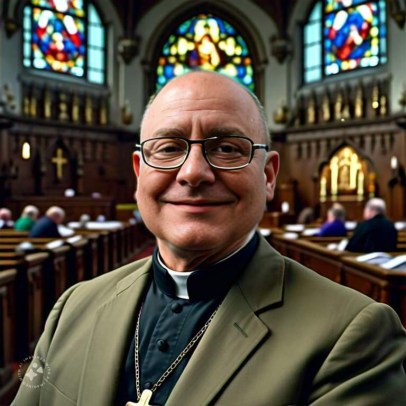
My Broken Life…and God’s Merciful Redemption

In 2015, I turned 50. I also moved my family to Connecticut to become the vicar of New Hope Anglican Church in Oakville. This was to be my “second career” ministry as I wanted to pastor the wonderful people of New Hope until I retired.

When I left Saint Robert, Missouri, I felt unaware of the awful earthquake coming to my marriage. Alisa and I were married in June 2004, had a beautiful special needs daughter that we both adored, and had navigated some choppy waters when I came home from Iraq in 2007. I loved Alisa very much, but I was not the perfect husband. She wasn’t the perfect wife either. In fact, she had an ulterior agenda I never knew. I later found out she started undermining our marriage the day after our legal wedding. She never told me she went to find out how to annul our marriage. Throughout our relationship, she was secretive and hid things from me. She didn’t deal with her own issues…she was more content to blame me for her personal lack of happiness or fulfillment in her life. In short, Alisa began planning to destroy our family from the beginning.

Alisa was my second wife. My first wife left me for another man. It was a similar story: Deb was secretive and deceptive, didn’t deal with her own personal issues, but blamed me for everything wrong in her life and her disappointment in our relationship. Whereas Alisa just destroyed our family and ran for home, Deb destroyed our family and took our children with her into a relationship with an abusive man who did untold damage to our children.

Truth is that I share responsibility for these two situations. My family of origin issues are plenteous…involving gender roles, communication, closeness and distance, and of course managing personal issues by blaming the other marriage partner for unhappiness. My targeting computer was flawless both times to select women guaranteed to recreate my parents’ marriage and then drag children into the mess. I am responsible.

After moving the family to Connecticut and beginning my ministry with New Hope, something went very wrong. Alisa was miserable. One day, our daughter and I were laughing and making funny little jokes about things when Alisa exploded. It was the event that brought me to the realization that she was struggling and frustrated to a flashpoint. We talked about the situation a couple of days later. I told her that her unhappiness was not something I could fix…that she needed to find her own answers. I would be with her and do what I could to encourage her and love her, but she needed to do the work.

Her answer was to move out and take our daughter back to Missouri.

Right away I contacted the man I thought was my bishop to explain what happened. In retrospect, resigning was the right decision at that point. Lesson learned…

What followed was a disaster of the highest order. Without getting into the weeds, Alisa eventually sued for divorce, I did resign from being the Vicar of New Hope, and my life turned upside down.

What made things worst was the bishops. Their level of incompetence was astounding. Their lack of honesty and boundaries was frankly the most unprofessional of any clerics I’ve ever seen or experienced. In short, I became the scapegoat and “bad guy”.

But it wasn’t just the two bishops involved, it was the lay leadership of the congregation. They treated me like I was a leper and left me to “die on the vine”. In fairness, one of the bishops directed them to behave that way, but they didn’t respond in Christian charity…and for that, I blame them for their choices.

It’s been ten years since all this played out. I disappeared from institutional church for 7 years because of the severe psychological trauma inflicted on me. By God’s grace and the wisdom of Mike and Susan Warnke, I was able to slowly make my way back…and now, my priesthood intact and restoration completed, I am able to function as a shepherd with Fr. John Prenger, a dear friend and my “boss”. He has helped restore trust in clergy.

Why am I sharing this story? It’s not to grind an axe. By God’s grace, I’ve forgiven the people involved in this sad time of my life…and believe they should be forgiven by everyone. No, I have two goals. First, I want to give hope to my fellow clerics that God’s gifts and callings are without repentance. You are not anathema if personal crisis comes. There is hope.

Second, I want to send a message to people who were harmed by one of the primary actors in my saga, Derek Jones. Again, you are not alone…his weaknesses and limitations personally and professionally cannot destroy your ministry and family unless you give in to the hatred and bitterness. Derek’s saga is a sad one…and is playing out in the press now. Do not rejoice in his suffering…pray for him and his family. But most importantly, take care of yourself and your families.

This is not the tale of a hero who overcame evil to rise like a phoenix from the ashes of destruction. God forbid you think that! I am a sinner who did so many things wrong in this drama…in marriage, in ministry, and in the aftermath of my sad defrocking. No, this is about a magnificent Savior…who graciously saved a sinner by grace. And if there is a hero here, it is Jesus Christ.

Worship him!

The Sweetest Smell

I sat down to write a blog entry about two bishops for the corruption and incompetence they contributed to an event that took place ten years ago. The goal was to expose these men publicly as a warning to those who find themselves “under” their leadership.

I deleted the post.

I could not adequately separate the facts of my case from my emotions. The post became venting and grinding an axe. The inner voice of the Holy Spirit warned me about exposing my process so publicly. The truth? I was playing in the same mud the two episcopal thugs threw around so wantonly. As the old story goes, when you wrestle with a pig you just get disgustingly dirty and the pig likes it!

Another story seems especially meaningful to this circumstance. In an interview done back in the 1990s, Dr. Wayne Dyer told a powerful and beautiful story about real forgiveness. HE said this: “Forgiveness is the aroma left from the flower of the shoe that crushes it.” This profound metaphor exposes my ongoing healing process, telling me the journey is only partly complete.

Fr. Terry Hedrick pastors Church of the Resurrection in Wichita, KS. He remains one of the most blunt and candid persons I know…so much so that it cuts through the normal nonsense down to the simple facts and truths many of us deny. He is a gem of a man and a great resource for his congregation.

At a clergy gathering, this writer made mention that of the desire to spare people the painful experiences experienced in ministry. Fr. Terry jumped in and reprimanded with his usual honesty. To paraphrase his statement, he said that we need to get over both the wounds that keep us in the past and focus our time and attention on what God wants from us in the future. This touched on the truth that too many times we wallow in our own self-pity and project a victim persona. Totally unproductive.

The time has come to put the past behind and strive for a better future. To stop focusing on the corruption and incompetence of others and focus on my own foibles, personality flaws, and areas of ignorance…so I can grow up and become what Christ destines for me.

I hope I can spread the fragrance of forgiveness to all those denied it over the years. And time to pray earnestly for those who need it from my past, both those who supported me in tough moments and those who chose another course of action.

Pray for me, a sinner.

Jimmy Swaggert: A Tale of Horrible Suffering

Jimmy Swaggert died about two weeks ago after an agonizing period of suffering from a cardiac event. His death, like his life, was a reminder to all of us who love Jesus that, “what goes around, comes around.” In this case, the agony of suffering is a theme in Jimmy’s life, which is the theme of this essay.

Swaggert was ordained by one of the most unusual organizations I know: The Assembly of God. They sponsored his ministry and took in millions of dollars from his music and crusade offerings. Their role in Jimmy’s suffering becomes clearer later in this journey, but we start here because the Assembly of God gave Swaggert his institutional credentials for his ministry, both as an evangelist and a Gospel singer.

Swaggert had no formal education. His theology showed it. His simplistic and often twisted hermeneutics left professional ministers puzzled by his claims. None perhaps more than his anthropology and soteriology. Swaggert taught that when a person is converted, they are totally washed clean…that they aren’t really “sinners” anymore. And then when they are “baptized in the Holy Ghost”, they are empowered to live the Christian life as “new men”…tempted, but without sin. So Jim Bakker – a man he helped expose for his own sins of the flesh – was obviously a charlatan to Swaggert, who went on multiple diatribes against Bakker on his ministry TV program. Like too many in Pentecostal circles, he also regularly committed the ancient heresy of Montanism. Essentially, this means that prophesy and other spiritual gifts can supersede the clear teaching of Scripture just by adding, “The Lord said…” This will also come back into this story…as we see a suffering man try to justify his sin by saying these very words.

In 1988, his theology was exposed for the public to see. Swaggert, a married man, was seen in the presence of prostitutes. The inference was clear that he was having sexual relationships outside of his marriage with women of the night. This behavior was more than just sinful, it revealed a serious flaw in his character and significant problems in his marriage. I won’t “psychoanalyze” Swaggert at this point…but I think it is safe to say that he was a man suffering on many levels, including his sexual appetite.

Re-enter the Assembly of God. Swaggert was pulled into a meeting with his local (and biased) leadership in the AOG where he was confronted for his grievous sin. Swaggert confessed apparently, which was both prudent and accurate. The end result was that the leaders of the AOG in Louisiana put him under a sort of discipline for 3 months – no public ministry – and he had to publicly confess his fall from his own pulpit. Swaggert agreed to those terms and he followed them.

Now enter the International leadership of the Assembly of God. They were not satisfied with these terms, so they dragged the Louisiana leadership into a meeting, demanding that Swaggert be silenced for two years. Y-E-A-R-S. This was what their governing documents required of a clergyman who needed rehabilitation in the wake of public sin. So the Louisiana AOG brought Swaggert back for another meeting and made clear he would need to stay out of the pulpit and the piano for two years.

Swaggert held a public press conference where he refused to abide by the two years because it would do too much damage to the ministry. My translation is that Swaggert was looking at the loss of millions of dollars from concerts, crusades, and television appeals. In other words, Swaggert was more motivated by dollars and cents than his own character and (most of all) his spiritual health.

The International Assembly of God defrocked Swaggert.

Then a few years later, Swaggert was found with another prostitute. This time, he went on his stage and told the gathered congregation that God told him to tell them it was none of their business. The spiritual smugness, arrogance, and temerity of such a move still shocks me to this day.

In the intervening years, multiple people who worked for the various departments of Jimmy Swaggert Ministries exposed the inner working and personalities of Swaggert and his wife, Frances. The “ministry” was a cash cow. The real power behind the scenes was not Jimmy, but Frances…who was apparently a nasty person to her staff and volunteers. The inference I draw from this is that Jimmy was in a marriage with a woman who was power hungry and drawn to material things more than a spirituality of compassion.

There were other reporters who dug deeper into Swaggert – including the man who broke the story of Swaggert’s dalliances with prostitutes. They suggested that Swaggert was playing fast and loose with tax and property laws to his advantage…all the while cloaking himself as the victim for what happened in 1988 and saying that he had no money.

Finally, as Swaggert’s health began to fail, his son and grandson grabbed ahold of his coattails and launched into new approaches to ministry. They launched a Christian TV network which was modestly profitable, which helped fuel their opulent lifestyles.

When Jimmy had a heart attack, the historical revisionism began from the pulpit of his church. His son, Donny, began describing his ailing father as the poor victim, whose ministry was responsible for millions of people coming to faith in Christ, and who was greatly misunderstood by the masses. No mention of his Fall from Grace.

And this past weekend, they buried this tortured and suffering man and held a memorial service where people could drown their grief by wallowing in a program about the greatness of Jimmy Swaggert.

It was a pathetic scene.

I’ve tried to be careful in writing these words. I don’t want to be unfair to Jimmy…I believe he is a pitiable figure. Sure, the man’s work was flooded with deception and cover-ups. He was a sex-addict. He was uneducated, but tried to portray himself as a Bible scholar to get some support for his preaching and ministry. And there is no doubt he was a top tier performer and musician.

But Jimmy Swaggert suffered throughout his life. I doubt he ever came to terms with his own dark side. I think his marriage was more a business partnership than the wonderful union that is available to those willing to invest in their mates and their relationship. He knew he was lying and covering up…and because he was also a man with a hunger for things spiritual, he probably had fits and bouts of guilt over it all.

No, I don’t relish this man’s death. The whole thing about heralding him as some champion of the Christian faith is as phony as the man’s real spirituality…paper-thin and absent from the depth of a genuine Christian transformation.

So as he goes to the ultimate day we all face, I pray for God’s grace for this man. Jimmy Swaggert is no different than all of us on some level. Like him, I’ve disappointed people by my dark side. I’ve walked in places where I never should have been…and consorted with people that were no good for me. And most of all, I’ve deceived myself and others about the real mess I am inside. I hide my brokenness and pain instead of rejoicing in the mercy and grace that allows me to look at those times as God’s loving work in a prodigal son.

Rest in peace, Jimmy. And may you now find in the face of Jesus the peace you were denied in your life among us.

Habemus Papam!

The pontificate of Leo XIV began on Thursday, May 8. The 1.3 billion Roman Catholics were ecstatic. Most of us from America were intrigued by the College of Cardinals electing an American as the Vicar of Christ – partly because we were told it could never happen. Most of the people in my orbit were pleasantly shocked and rejoiced with our Roman Catholic brothers and sisters in this choice.

I do not envy Pope Leo. He becomes Pope at a time of turmoil in both the Roman Catholic Church and the world. His predecessor (who made him a cardinal, btw) left him a church that has more questions about the future than it has answers. Francis was steeped in the liberation theology of his time and was swayed by the social side of the church. Some found his liberality and synodality a welcome change from the conservatism of John Paul II and Benedict XVI. Others saw Francis, the first Jesuit Pope, as a heterodox leader whose initiative for priests to bless same-sex unions as a serious violation of the church’s moral teaching about the sacrament of marriage. Pope Leo is inclined to follow the same path as Francis socially, but there is a sense of strength in Leo’s adherence to Catholic dogma. We shall see how he handles this.

There are several hot spots in the world that reminds us that violence and war are still seen as viable tools in statecraft. The most obvious is the war between Russia and Ukraine, now entering its third year with no apparent end in sight. Another sore spot in the world is the ongoing war between Israel and the terrorists in Palestine sworn to murder not the Jews of the Middle East, but around the world. Finally, the on-again, off-again tension between India and Pakistan over Kashmir flared up concurrently with Leo’s election. Leo needs to use whatever influence the Vatican can muster to bring these warring nations to the negotiation table and bring the conflicts to an end. Can Leo do it? Time will tell.

This I know…we Christians should be quick to pray for our dear brother now Pope Leo XIV. He needs our spiritual support to accomplish his mission as the leader of the largest sect of Christianity. At the same time, we should be reluctant to judge too harshly or quickly. Give the man a chance.

THATISALL

A Fresh Approach to Servant Leadership

Leadership always got my attention as a young man. I saw a lot of leaders before I turned 21. I remember my athletic coaches by name. Many of the teachers who endured me as a student left impressions on me – some good, some less so.

Jesus’ disciples were also interested in leadership. In fact, we shared a common approach. I believed that leaders were “in charge” and told people what to do. This was modeled to me over and over growing up.

Eventually, I saw that this doesn’t work. People don’t like being pushed around…*I* certainly don’t. Then I was introduced to a new idea of leadership: servant leadership.

Jesus taught and practiced this approach. He washed his disciples’ feet. When they would fuss with each other about who was the greatest, he brought in little children and said, “This is what it’s all about.”

I was enamored. No more yelling. No more berating…just serve the people you lead. It made sense. I practiced servant leadership all my life from my mid-20s going forward.  The theory worked well. Occasionally, however, someone would come along that would take advantage of me. I had a female employee who accused me of being inappropriate with her because I gave her a sympathetic ear and a should to cry on. The accusation was baseless, but not uncommon in the 1990s. Servant leadership in this case led to one of the worst professional crises of my life.

When I worked on my Ph.D in leadership, I learned many approaches. The one that got my attention early on was “existential” leadership. Essentially, it meant determining a leadership approach not on the style the leader liked but rather the needs of the employee. When trust and competency was high, a leader could be more relaxed and laissez-faire. But where trust or competency was low, the leader needed a more active and even micro-managing set of behaviors.

As I was developing a better theory of leadership during my coursework, I had a staff member that received multiple counseling statements for sub-par behavior and performance. Eventually, I made the decision to fire this member of my team because he was so substandard and showed no capacity to learn from mistakes or corrective training.

This experience taught me that a leader must never put the desires or even needs of a substandard member before the mission of the organization. Supervisors have a duty to protect their organizations by not handing off problem people down the line. A good supervisor must look after the whole team, reward appropriate performance, promote those who excel, and (sadly) eliminate problem employees when they become a detriment.

Can a servant leader be an effective manager? I believe that is a case-by-case situation. Two important qualities of the employee make servant leadership appropriate: (1) High motivation and, (2) high competency.

As a leader of a brigade team, I had very competent subordinates. As a result, I did everything I could to simply keep everyone from distracting these teammates and make it easy for them to focus on their jobs. I could be a servant leader easily in this case because I had the right kind of people.

But shortly after my tenure ended at the brigade, I had another situation emerge where I helped send an employee out of the military and into civilian life. This teammate was so racked with personal and emotional problems that there was no way anything could bring redemption. I drove this person to the airport after making sure the out-processing steps were completed by the numbers.

I believe an expansion of servant leadership is important. Yes, leaders serve their teams and help them. But the first duty of a supervisor is to insure the team performs…that the team serves the organization’s mission by providing appropriate service to its customers. Sometimes the best servant leadership is to fire an employee or issue a reprimand or put together a P.I.P. (personal improvement program).

Servant leadership is still my go-to approach to leadership. But now its based in the real world…not in the “pie-in-the-sky” world of my youthfulness.

Divorce, Culture, and Vocational Ministry

The United States suffers from two massive frauds: Federal government tyranny and the ease in which couples divorce and destroy their families. I’m rather infamous for bloviating about the first, but not nearly enough to lambast the latter.

Before diving in, there’s a few things to clear up from the beginning. I’m a twice divorced person, though in both cases, my wives sought the divorce over my strenuous objections. In addition, the vocational pursuit of my life has been Christian ministry. My current denomination (The International Communion of the Charismatic Episcopal Church) has a very specific rule about divorced clergy that I’m vowed to support. Finally, I am a student of the Bible…not just the texts themselves, but also the cultural backgrounds of those sacred writings that help us understand the intentions of the authors.

Divorce in the ancient world was a reflection of the patriarchy. Women had no power over who they married – their parents arranged that. As a result, divorce was a rare occurrence. Generally, the man was the only person empowered to divorce his wife, though there were exceptions to this rule, especially in European empires like the Greeks and Romans.

Divorce laws in Western civilization changed as marriages became the choice of the partners and family influence over these unions waned. By the mid-1800’s, women could freely divorce their husbands, but only under certain conditions like repeated adultery, physical abuse, or abandonment. This was further changed in the 1900’s when “no fault” divorce laws allowed either party to divorce for any reason at all.

The divorce rate in the United States in 1900 was around 8% according to a Valerie Schweitzer, a researcher from Bowling Green State University. When the “no fault” divorce laws began to affect couples, the divorce rate was at 9%. Within 40 years, that rate spiked to 52%. The current rates (according to the study from 2018) are around 45% in rough numbers.

The historic church developed rules about the clergy over the centuries from the time of the Apostles based on several factors: Judaism’s practices, the teachings of the Old and New Testaments, the current laws of the geographical areas, and the practices of the church in the business of marriage and family life. In the early church, there was nothing specific mentioned about leadership’s familial status, but the Apostle Paul made several important rules that exist in his letters to this day.

The general practice of the church in the Medieval centuries was for a member of the clergy to be male (yes, there were female clergy but that’s for another time…) and have one wife. Tradition has suggested that this meant a man could only have one wife in his lifetime. So if a deacon’s wife died or he divorced her, he must remain single or lay down his orders. This was true for bishops and presbyters as well.

This practice continues today in the Eastern Orthodox tradition and Roman Catholic in those extremely rare conditions where their priests are married and their deacons (who are allowed to be married as a matter of canon law).

But is this tradition the correct or the best reading of those texts concerning, “the husband of one wife”? I say no for two important reasons: The texts are rather clear in how they are written that the issue is not one wife throughout the life of the man, but rather he cannot more than one wife at a time. Second, the sacred tradition of the Church was dealing with a whole different set of circumstances than we have in current society. For example, a divorced presbyter at the time (unless he was married to a Roman citizen for a wife) must have been the divorcing party…and that was an arranged marriage, which meant their were political ramifications behind the divorce.

There is a pastoral concern that the current practice does not address. Divorce.com says that women initiate divorce in 70% of divorces. That number rises to over 90% when the wife has a college degree. To a large degree, women are now the initiators of divorce, which may explain why the divorce rate is so high in Western Society.

The fathers of the Church created a system that worked for centuries in a world where the conditions were different. Do we really think that our forebears wanted a system where a cleric’s wife could divorce him for any reason, which necessarily ended that cleric’s ministry?

In my next blog entry, I will discuss the remarriage of divorced or widowed clergy…and why forcing clergy to be single can be very dangerous.