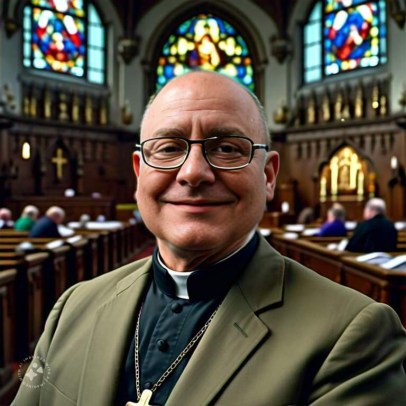

In 2015, I turned 50. I also moved my family to Connecticut to become the vicar of New Hope Anglican Church in Oakville. This was to be my “second career” ministry as I wanted to pastor the wonderful people of New Hope until I retired.
When I left Saint Robert, Missouri, I felt unaware of the awful earthquake coming to my marriage. Alisa and I were married in June 2004, had a beautiful special needs daughter that we both adored, and had navigated some choppy waters when I came home from Iraq in 2007. I loved Alisa very much, but I was not the perfect husband. She wasn’t the perfect wife either. In fact, she had an ulterior agenda I never knew. I later found out she started undermining our marriage the day after our legal wedding. She never told me she went to find out how to annul our marriage. Throughout our relationship, she was secretive and hid things from me. She didn’t deal with her own issues…she was more content to blame me for her personal lack of happiness or fulfillment in her life. In short, Alisa began planning to destroy our family from the beginning.
Alisa was my second wife. My first wife left me for another man. It was a similar story: Deb was secretive and deceptive, didn’t deal with her own personal issues, but blamed me for everything wrong in her life and her disappointment in our relationship. Whereas Alisa just destroyed our family and ran for home, Deb destroyed our family and took our children with her into a relationship with an abusive man who did untold damage to our children.
Truth is that I share responsibility for these two situations. My family of origin issues are plenteous…involving gender roles, communication, closeness and distance, and of course managing personal issues by blaming the other marriage partner for unhappiness. My targeting computer was flawless both times to select women guaranteed to recreate my parents’ marriage and then drag children into the mess. I am responsible.
After moving the family to Connecticut and beginning my ministry with New Hope, something went very wrong. Alisa was miserable. One day, our daughter and I were laughing and making funny little jokes about things when Alisa exploded. It was the event that brought me to the realization that she was struggling and frustrated to a flashpoint. We talked about the situation a couple of days later. I told her that her unhappiness was not something I could fix…that she needed to find her own answers. I would be with her and do what I could to encourage her and love her, but she needed to do the work.
Her answer was to move out and take our daughter back to Missouri.
Right away I contacted the man I thought was my bishop to explain what happened. In retrospect, resigning was the right decision at that point. Lesson learned…
What followed was a disaster of the highest order. Without getting into the weeds, Alisa eventually sued for divorce, I did resign from being the Vicar of New Hope, and my life turned upside down.
What made things worst was the bishops. Their level of incompetence was astounding. Their lack of honesty and boundaries was frankly the most unprofessional of any clerics I’ve ever seen or experienced. In short, I became the scapegoat and “bad guy”.
But it wasn’t just the two bishops involved, it was the lay leadership of the congregation. They treated me like I was a leper and left me to “die on the vine”. In fairness, one of the bishops directed them to behave that way, but they didn’t respond in Christian charity…and for that, I blame them for their choices.
It’s been ten years since all this played out. I disappeared from institutional church for 7 years because of the severe psychological trauma inflicted on me. By God’s grace and the wisdom of Mike and Susan Warnke, I was able to slowly make my way back…and now, my priesthood intact and restoration completed, I am able to function as a shepherd with Fr. John Prenger, a dear friend and my “boss”. He has helped restore trust in clergy.
Why am I sharing this story? It’s not to grind an axe. By God’s grace, I’ve forgiven the people involved in this sad time of my life…and believe they should be forgiven by everyone. No, I have two goals. First, I want to give hope to my fellow clerics that God’s gifts and callings are without repentance. You are not anathema if personal crisis comes. There is hope.
Second, I want to send a message to people who were harmed by one of the primary actors in my saga, Derek Jones. Again, you are not alone…his weaknesses and limitations personally and professionally cannot destroy your ministry and family unless you give in to the hatred and bitterness. Derek’s saga is a sad one…and is playing out in the press now. Do not rejoice in his suffering…pray for him and his family. But most importantly, take care of yourself and your families.
This is not the tale of a hero who overcame evil to rise like a phoenix from the ashes of destruction. God forbid you think that! I am a sinner who did so many things wrong in this drama…in marriage, in ministry, and in the aftermath of my sad defrocking. No, this is about a magnificent Savior…who graciously saved a sinner by grace. And if there is a hero here, it is Jesus Christ.
Worship him!

 Fr. Jim McNeely